
Hybrid Inverter Manufacturers in China for Grid Forming Microgrids
casinoglowzone >> Blog>> Hybrid Inverter Manufacturers in China for Grid Forming MicrogridsHybrid Inverter Manufacturers in China for Grid Forming Microgrids
Removing the utility connection from a microgrid diagram exposes a dependency that can remain unnoticed during normal grid operation: the source of its voltage and frequency reference. Stored energy alone does not establish that reference at an AC bus. An islanded installation needs equipment capable of establishing the electrical supply, controls that coordinate its operation and a defined route for restarting after a complete shutdown.
A Local Electrical Reference
AC loads require a usable voltage waveform and frequency at the point supplying them. Grid-forming equipment establishes a local reference around which an island can operate, rather than relying solely on an existing external supply. That distinction gives an assessment of hybrid inverter manufacturers in China a specific control function to investigate.
A converter following an energized network can regulate its contribution against the reference already present. Removing that network changes the operating problem: the installation must retain another suitable reference or establish one locally. Merely connecting sufficient battery capacity does not identify which device takes that responsibility.
Reference responsibility belongs to a particular bus within the selected island operating boundary. A transformer can place connected equipment at another voltage level, so the microgrid description must locate the reference and the loads it supports. The single-line arrangement keeps those relationships visible during island operation.
The reference also has to remain compatible with the connected equipment as demand changes. Voltage, frequency and available power belong in the island operating specification together. Generating an AC waveform is therefore the beginning of the supply task, with current limits and the resources sustaining that waveform still constraining the duty.
Control Modes Describe Operating Objectives
Active and reactive power control concerns the exchange of power, while voltage and frequency control concerns the local electrical reference. Control objectives establish the practical basis for discussions with hybrid inverter manufacturers in China before selectable mode names are compared. The operating arrangement determines which objective is appropriate at a particular stage.
PQ commonly denotes active and reactive power control, and VF denotes voltage and frequency control. VSG refers to virtual synchronous generator control, which uses control behaviour associated with synchronous generation. These labels identify control concepts; the available functions and transitions must still be established for the particular converter and system configuration.
Parallel equipment introduces a coordination task alongside each unit’s control objective. Several converters connected to one bus cannot be assessed as unrelated sources simply because each carries a grid-forming description. Their contributions need an agreed operating relationship, including how the installation responds when a unit becomes unavailable.
Changes in active power require an energy exchange with the DC resources. Control organizes that exchange but cannot replace unavailable stored energy or generation. The intended island duty therefore includes a control relationship and a source capable of sustaining the requested contribution for its duration under the specified operating conditions.
An energy-management instruction can request a charge or discharge duty without itself creating the AC reference. The supervisory operating target and the converter’s electrical control consequently occupy different levels. Recording both prevents a dispatch-mode description from being mistaken for the complete island-control arrangement.
Restarting an Unenergized Installation
Black start addresses recovery from an unenergized condition, rather than continued operation of an already established island. Auxiliary supplies, an available energy source and the sequence for energizing equipment are part of that recovery task. An installation can have a defined island operating mode while its restart procedure still requires separate examination.
The recovery sequence sets requirements for hybrid inverter manufacturers in China before equipment is energized. It identifies the first available source, the equipment energized next and the conditions permitting subsequent connections. Where several units participate, coordination must cover the start itself as well as their later parallel operation.
Restoring supply also changes the demand presented to the recovering system. Connecting every retained duty at once may create a different event from reconnecting loads in stages. The restart assessment follows that event through the available power and energy, without treating a black-start label as an unlimited restoration commitment.
A Megawatt Platform in the Microgrid Arrangement
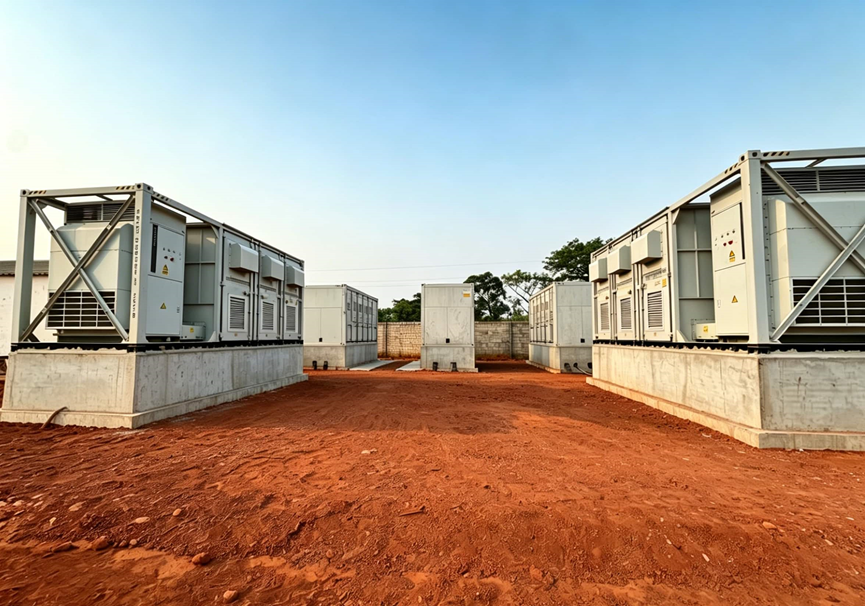
For a multi-unit island requiring these functions, GWTime supports grid forming, coordinated multi-unit black start and parallel island operation in its 2500 kW hybrid-inverter family. The 1500 V architecture supports VSG, PQ and VF modes. These stated functions provide a platform reference for the distinct reference, control and recovery tasks already identified.
Two GWTime configurations place that platform at different output boundaries. GWP2500TS-400-A provides 400 V rated output through a 2500 kVA, 690/400 V transformer arrangement; GWP2500TS-35000-A provides customizable 35 kV output through a 2500 kVA, 690 V/35 kV arrangement. The receiving installation therefore remains part of selecting the output configuration.
Within the GWTime DC-coupled solution, battery cabinets supply energy-shifting and backup capacity while PCS handles power conversion and dispatch. EMS coordinates operation from system parameters. Those responsibilities connect the inverter platform to stored energy and supervisory operation, without making the battery cabinet itself the device establishing the AC reference.
Grid forming specifies how a local electrical reference is established; operating modes organize control; black start concerns recovery. An applicable configuration brings those duties together with the connected energy resources and a coordinated restoration sequence. Sustained island supply rests on that combined arrangement throughout the intended operating event.
Related Post
WinPlace NL beveiligingsgids – veilig spelen met licentie van de Kansspelautoriteit
WinPlace NL – Praktische Gids voor Nederlandse Spelers Wat is WinPlace NL? WinPlace is een…